

Signs of a Good Injector: How to Choose Your Aesthetic Professional in 2026
- The Pond Parlor

- Jul 10
- 11 min read
Updated: Jul 14
The era of the aesthetic "Wild West" is over. In 2026, choosing a practitioner is no longer about finding the lowest price per syringe; it is about securing a hybrid of medical safety and high-end visual artistry. You deserve a transformation that feels like indulgent self-care, not a medical gamble. Identifying the specific signs of a good injector is the only way to avoid the "frozen face" or "duck lip" results that dominate social media horror stories.
You likely feel the pressure of London’s saturated market. It is confusing to navigate varying price points while worrying about unlicensed products or practitioners without proper oversight. We understand that anxiety. This article promises to clarify the indicators of a truly elite professional. You will learn how to verify clinical credentials, recognize the new "traffic light" safety system, and ensure your results remain subtle and sophisticated. We explore the benchmarks of modern excellence, from Level 7 Diplomas to the precision of regenerative "Micro-Tox" techniques. Clinical precision. Aesthetic mastery. Peace of mind.
Table of Contents
Medical Qualifications and Credentials: The Non-Negotiable Signs of a Good Injector
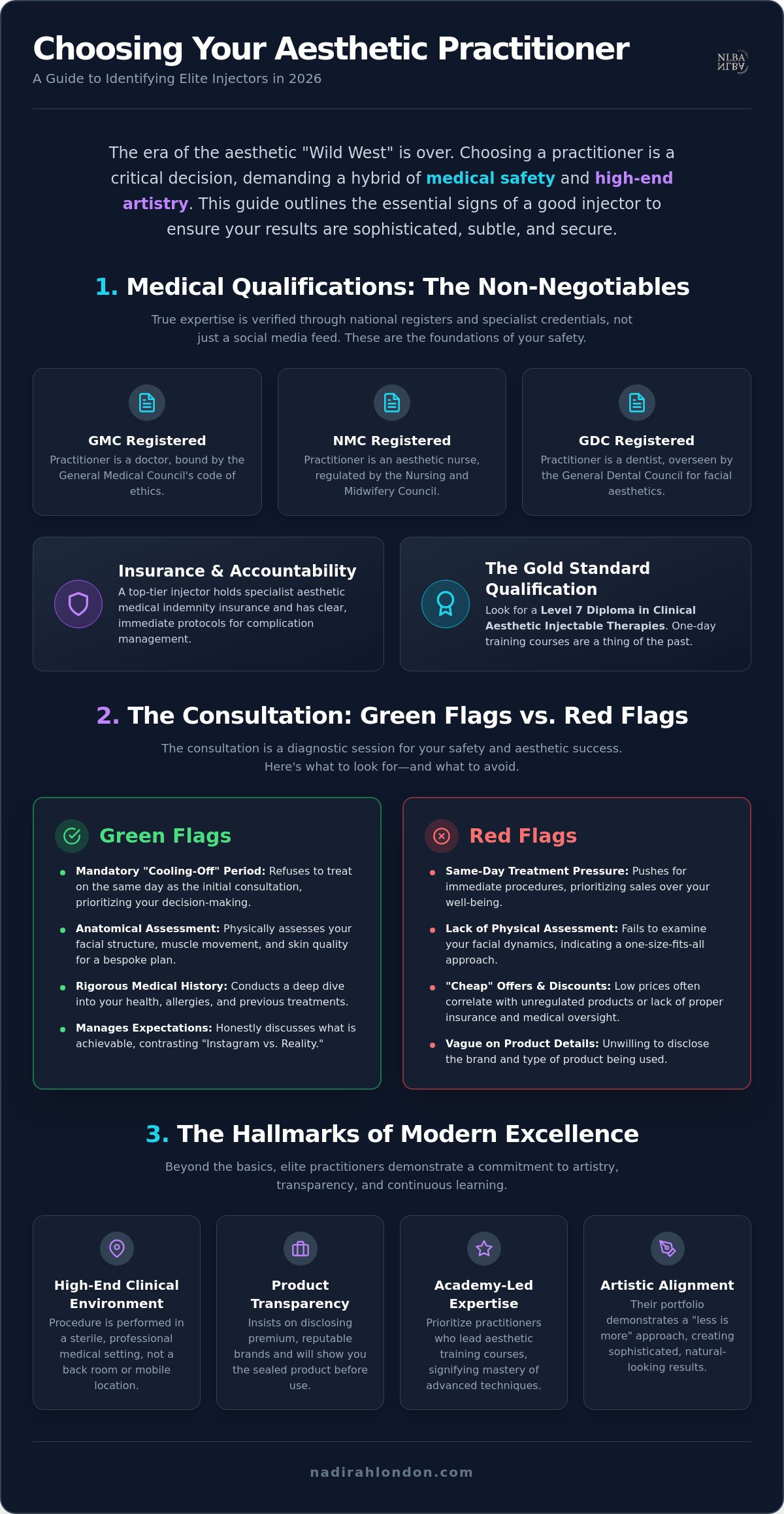
Clinical precision defines the modern aesthetic experience. In the sophisticated London market, the most critical signs of a good injector are found in their professional credentials. A practitioner’s ability to perform an Injectable filler procedure is not just an artistic skill; it's a medical intervention requiring deep anatomical knowledge. True expertise is verified through national registers and clinical insurance, not just a curated social media feed.
To better understand the technical precision required for these procedures, watch this helpful video:
Understanding Professional Registrations in London
The UK aesthetic industry is currently undergoing a rigorous transition toward mandatory licensing. A reputable practitioner must be registered with a recognized professional body. These registers provide a public record of accountability and training.
General Medical Council (GMC): The regulatory standard for doctors.
Nursing and Midwifery Council (NMC): The oversight body for aesthetic nurses.
General Dental Council (GDC): The registration body for dentists performing facial aesthetics.
Registration ensures the practitioner is bound by a code of ethics and subject to professional discipline. It's the first non-negotiable green flag. If a name doesn't appear on these public registers, they're operating outside the medical safety net. In 2026, a Level 7 Diploma in Clinical Aesthetic Injectable Therapies is the gold standard for qualification. The era of one-day training courses is officially over.
Insurance and Accountability
High-end aesthetics require more than just a steady hand. They require a safety infrastructure. A good injector always holds specialist aesthetic insurance. This isn't standard public liability; it's specific coverage for cosmetic complications and medical indemnity. Healthcare professionals are trained to manage adverse events like vascular occlusions or allergic reactions immediately using emergency protocols.
Ask these specific questions during your initial contact:
Which professional body are you registered with?
Do you have specialist aesthetic medical indemnity insurance?
What are your emergency protocols for complication management?
Do you have hyaluronidase on-site to dissolve filler if necessary?
"Cheap" offers often signal a lack of these safeguards. Low prices frequently correlate with unregulated products or a lack of medical oversight. Safety is the ultimate luxury. A practitioner who can't provide proof of registration or insurance is a significant red flag. Identifying these signs of a good injector before your procedure ensures that your transformation is both beautiful and medically secure.
The Consultation Process: Red Flags vs. Green Flags
The consultation is a diagnostic session. It is the foundation of medical safety and aesthetic success. One of the undeniable signs of a good injector is the refusal to treat you on the same day as your initial inquiry. This mandatory "cooling off" period allows you to process information without the pressure of a sales environment. A professional prioritizes your long-term health over immediate turnover.
During this phase, a practitioner studies your unique facial architecture. They assess muscle movement, bone structure, and fat pad distribution. This dynamic assessment ensures that results look natural when you speak, smile, or frown. If an injector doesn't touch your face or ask you to make various expressions, they aren't assessing you properly. Bespoke medicine requires a bespoke plan.
Green Flags: What a Professional Will Ask You
Expect a rigorous screening process. A skilled professional conducts a deep dive into your medical history. They will ask about autoimmune conditions, recent dental work, and previous aesthetic treatments. They also manage expectations regarding "Instagram vs. Reality." A good injector is honest about what fillers can and cannot achieve. Transparency regarding risks is also vital. Reviewing FDA information on dermal fillers can help you understand that even minor tweaks carry biological weight that requires expert management.
Red Flags: When to Walk Away
High-pressure sales tactics are the ultimate warning sign. If a practitioner offers "buy one, get one free" deals or discounts for multiple areas on the spot, walk away. Medical procedures should never be treated as retail commodities. Other red flags include:
Lack of a sterile, clinical environment.
Refusal to show a portfolio of their own work.
Defensiveness when asked about their training or complication rates.
Rushing through the risks or dismissing your concerns.
The consultation is your opportunity to interview the practitioner. Don't be afraid to ask for specifics. Sophisticated practitioners who lead or attend an aesthetic training course often exhibit the highest standards during these assessments. They understand that identifying the signs of a good injector starts with the quality of the conversation, not the speed of the needle. Ethical practice is always rooted in patient education and clinical precision.
Product Transparency and Clinical Environment
Excellence in aesthetics is visible in the details. One of the most telling signs of a good injector is their refusal to compromise on product sourcing. In a market where unlicensed products have led to severe complications, including 38 recorded cases of botulism poisoning in England in July 2025, transparency is the ultimate luxury. A professional practitioner treats the syringe as a medical device, not a retail commodity.
FDA-Approved and Premium Dermal Fillers
Elite clinics prioritize high-performance, extensively researched brands. You should expect your practitioner to use industry leaders such as Juvederm or Restylane. These products offer superior tissue integration and predictable longevity. Consulting a resource like the American Board of Cosmetic Surgery fillers guide confirms that FDA-cleared products are the only acceptable option for patient safety and natural results.
Avoid "budget" or "no-name" fillers often marketed on social media. These frequently lack the cross-linking technology required for sophisticated facial contouring. A transparent professional will always:
Show you the unopened product packaging before the procedure.
Allow you to verify the expiry date and batch number.
Provide a sticker or record of the specific product used for your personal files.
Explain why a specific rheology (thickness) was chosen for your anatomy.
The Clinical Setting
The environment where you receive treatment is a direct reflection of a practitioner's standards. Home visits or "mobile injecting" are significant red flags. These settings lack the sterile infrastructure required to prevent infection. A professional London clinic adheres to rigorous hygiene protocols, mirroring a surgical environment. Clinical precision requires controlled lighting, adjustable treatment beds, and immediate access to emergency equipment.
Safety also demands the presence of Hyaluronidase. This is a prescription-only enzyme used to dissolve hyaluronic acid fillers in the event of a vascular emergency or unsatisfactory result. A good injector never operates without it on-site. If a practitioner cannot show you their dissolving agent, they aren't prepared for complications.
Finally, your clinical record must include high-resolution "Before and After" photography. These aren't for marketing; they're essential medical documents. They allow for an objective assessment of volume changes and symmetry over time. Precise documentation is one of the definitive signs of a good injector, ensuring your aesthetic journey is tracked with clinical rigor and professional accountability. Results should be measurable, secure, and consistently sophisticated.
Assessing Artistic Style: Finding Your Aesthetic Match
Aesthetic enhancement is a visual craft. It requires more than technical accuracy; it demands an eye for symmetry, balance, and facial architecture. One of the primary signs of a good injector is their ability to see the face as a cohesive unit rather than a collection of isolated features. In 2026, the global trend has shifted away from the "overfilled" look toward restorative, subtle refinements that respect your natural movement.
Finding your aesthetic match involves auditing a practitioner's visual philosophy. Every injector has a signature style. Some specialize in high-definition contouring, while others focus on undetectable "micro-tweaks." Your goal is to find a professional whose previous work reflects the version of yourself you wish to achieve. Results should look effortless, not engineered.
Portfolio Integrity
In an age of digital manipulation, a practitioner’s portfolio must be scrutinized for authenticity. Static photos only tell half the story. Look for these markers of a genuine portfolio:
Video Results: High-resolution videos show how the face moves during speech and expression. This ensures the signs of a good injector include results that don't look "frozen" or "heavy" in motion.
Lighting Consistency: Before and after photos should have identical lighting, angles, and backgrounds. Shadows can be used to hide filler migration or poor placement.
Demographic Range: A versatile professional demonstrates success across different age groups, ethnicities, and skin types.
Unfiltered Texture: Real skin has pores and fine lines. If every photo looks blurred or airbrushed, the practitioner is likely hiding technical flaws.
The Consultation as an Artistic Assessment
A sophisticated professional will often challenge your requests. If you ask for lip filler but your practitioner explains that mid-face support is actually what you need for a natural lift, they are prioritizing facial harmony over a quick sale. This holistic approach is a hallmark of elite practice. They understand that adding volume to one area can negatively impact the proportions of another.
The power of "no" is a significant green flag. A good injector will refuse a treatment if they believe it will lead to an unnatural result or compromise your long-term aesthetic health. They also insist on a follow-up appointment. This allows them to assess how the product has settled into your tissues and ensure the final result meets their high standards of precision.
Artistic mastery is a learned skill. Professionals who have completed an advanced aesthetic training course are often better equipped to manage complex facial ratios and deliver the "less is more" results that define modern luxury. Prioritize a practitioner who views your face as a masterpiece, not a canvas for over-treatment.
The Nadirah London Standard: Why Academy-Led Clinics Excel
Academy-led clinics represent the pinnacle of modern aesthetic medicine. When a practitioner is responsible for training the next generation of professionals, their own clinical standards must be beyond reproach. This dual identity as both a high-level clinician and an industry educator is one of the most reassuring signs of a good injector. It signals a mastery of both the technical application and the biological theory behind every procedure. At Nadirah London, clinical precision is not just a goal; it is the foundation of our educational curriculum.
From Practitioner to Educator
The depth of knowledge required to run an accredited aesthetic academy is extensive. It involves staying at the forefront of global trends, from advanced cross-linking technologies in fillers to the latest neuromodulator onset times. Teaching others reinforces high safety standards and ensures that every injection is performed with academic rigor. As a premier London destination for both elite treatments and professional training, we offer a unique environment where precision and skill are paramount. Practitioners who teach are constantly audited by their peers and students, creating a culture of transparency and continuous improvement.
A sophisticated clinic provides a comprehensive suite of interventions to ensure results-driven, professional care. Our service menu is designed for quick navigation and immediate results:
Dermal Fillers: Precision volume restoration and contouring.
Anti-Wrinkle Injections: Targeted neuromodulation for a refreshed appearance.
Advanced Facials: High-performance skin quality optimization.
BioFiller and PRP/PRF: Autologous regenerative treatments for natural enhancement.
Liquid BBL: Non-surgical body contouring with clinical expertise.
IV Vitamin Drips: Holistic wellness and systemic hydration.
Booking Your Bespoke Transformation
Your journey begins with a professional consultation. This is where we translate your aesthetic goals into a structured clinical pathway. At Nadirah London Beauty Clinic & Academy, you can expect an environment focused on the technical craft of physical enhancement. We avoid descriptive filler and prioritize high-impact results through targeted cosmetic procedures. We believe that identifying the signs of a good injector should lead you to a destination where expertise is shared and excellence is standard.
Don't settle for anything less than academy-level precision. Secure your place in a professional environment where safety and artistry intersect perfectly. Book your consultation at Nadirah London today and experience the standard of care that defines the future of London aesthetics.
Securing Your Aesthetic Future
Your journey toward aesthetic enhancement in 2026 demands a fusion of clinical precision and artistic vision. By prioritizing medical registration, product transparency, and a holistic approach to facial harmony, you ensure your results are both secure and sophisticated. Identifying the signs of a good injector is the final step in moving beyond basic beauty treatments toward high-end medical transformation. True luxury lies in the peace of mind that comes from expert hands, and for other specialized health needs like travel vaccinations, you can discover DKliniek to maintain that same standard of care.
Nadirah London sets the benchmark for excellence as an Accredited Aesthetic Training Academy. Our specialists in Dermal Fillers and Anti-Wrinkle Injections deliver results-driven clinical expertise to clients across Greater London. We don't just perform treatments; we lead the industry in safety and technique. This educational foundation ensures that every procedure we conduct meets the highest possible standards of accuracy and care.
View our range of Aesthetic Treatments and book your consultation
You're now equipped to choose a professional who values your safety as much as your silhouette. We look forward to welcoming you into a world of refined, professional care where your transformation is our primary craft.
Frequently Asked Questions
What is the most important qualification for an injector in the UK?
Registration with a professional medical body like the GMC, NMC, or GDC remains the primary standard for safety and accountability. In 2026, a Level 7 Diploma in Clinical Aesthetic Injectable Therapies is recognized as the master's-level benchmark for excellence. This qualification ensures the practitioner possesses deep anatomical knowledge and the ability to manage complex medical complications. Always verify these credentials on the official public registers before booking your transformation.
Can a non-medic be a good injector?
Under the national licensing scheme introduced in 2026, non-healthcare professionals can only perform medium-risk treatments like anti-wrinkle injections under the oversight of a qualified healthcare professional. While some non-medics possess technical skill, they lack the independent prescribing rights and medical training required to manage severe complications like vascular occlusions. Choosing a medical professional is one of the clearest signs of a good injector who prioritizes your clinical security.
How do I know if an injector is using genuine products?
Genuine injectors use premium, FDA-cleared brands like Juvederm or Restylane and are fully transparent about their sourcing. You should see the practitioner open the product from its original, sealed packaging in your presence. Ask to see the box, which must display a batch number and a valid expiry date. A professional clinic will provide you with a record of this information for your personal medical files after the procedure.
Is it a bad sign if an injector refuses to do a treatment I asked for?
Refusal is actually a significant green flag and a mark of clinical integrity. A professional injector prioritizes facial harmony and your long-term health over immediate profit. If they believe a treatment will look unnatural, cause "filler fatigue," or pose a medical risk based on your unique anatomy, they have a professional duty to say no. This honesty demonstrates they're committed to delivering sophisticated, results-driven outcomes rather than over-treating.
What should I see in a professional aesthetic clinic environment?
A professional environment should mirror a high-end surgical suite rather than a traditional beauty salon. You should see clinical-grade cleanliness, sharps bins for safe needle disposal, and specialized treatment beds with adjustable lighting. The presence of emergency kits containing Hyaluronidase and oxygen is mandatory. Mobile services or home visits are significant red flags as they cannot maintain the sterile conditions required for invasive injectable procedures in a controlled setting.
How much should I expect to pay for a good injector in London?
Expect to pay a premium that reflects the practitioner’s experience, medical insurance, and the quality of the products used. In London, pricing is typically tiered based on the complexity of the treatment and the injector’s credentials. Lower-than-average prices often indicate that a clinic is cutting corners on safety protocols or using unlicensed products. Investing in a highly qualified professional reduces the long-term risk and cost of correcting poorly executed results.
What are the signs of a botched injection to watch out for?
Immediate warning signs include severe pain, skin blanching, or a mottled "net-like" appearance on the skin, which can indicate a vascular emergency. Long-term signs of poor technique include visible lumps, filler migration, or significant asymmetry that ignores your natural bone structure. If you experience any of these, contact your practitioner immediately. A good injector will have clear emergency protocols and dissolving agents in place to address these issues instantly.
Why is a consultation necessary before my first treatment?
A face-to-face consultation is a legal requirement for prescription-only medicines like botulinum toxin and is essential for thorough medical screening. This session allows the practitioner to assess your anatomy, discuss risks, and verify your medical history. It also provides a mandatory "cooling off" period. This time ensures you aren't making an impulsive decision and allows you to confirm that the practitioner exhibits all the signs of a good injector before proceeding.


Comments