

Is Non-Surgical Rhinoplasty Safe? Everything You Need to Know in 2026
- The Pond Parlor

- Jun 18
- 12 min read
In 2023, 7.7 million aesthetic treatments were performed across the UK, marking a significant shift toward non-invasive profile refinement. Despite this popularity, the central question for many remains: is non-surgical rhinoplasty safe? It's natural to feel a mix of desire for transformation and anxiety regarding needle proximity to the eyes or conflicting social media data. You require more than a trend; you need a professional, results-driven understanding of clinical safety and procedural precision.
This guide offers an authoritative look at the 2026 safety landscape for liquid nose jobs in London. Clinical safety profiles. Potential vascular risks. Mastery of nasal anatomy. We'll examine the impact of new UK licensing requirements and the specific criteria for selecting an elite clinic. Expect a transparent breakdown of the latest filler technologies and the steps required to ensure a sophisticated, low-risk result. High-end expertise meets clinical precision. Everything you need for total confidence in your aesthetic transformation.
Key Takeaways
Clinical benefits of Hyaluronic Acid. Immediate reversibility and biocompatible profile refinement for predictable results.
Anatomical mastery and medical history. Critical factors in determining whether is non-surgical rhinoplasty safe for your specific profile.
Risk assessment for complex cases. Understanding why previous surgical rhinoplasty requires advanced practitioner expertise and specialized screening.
Credential verification in London. Selecting premium clinics through GMC or NMC registration and evidence of Academy-level training status.
Safety monitoring protocols. Recognizing essential clinical markers like capillary refill and vascular health during the injection process.
Table of Contents
Understanding Non-Surgical Rhinoplasty Safety in 2026
Non-surgical rhinoplasty involves the strategic application of Hyaluronic Acid (HA) fillers to refine the nasal bridge, tip, and overall profile. This procedure offers a sophisticated alternative to traditional surgery, focusing on facial balancing and subtle transformation. When considering whether is non-surgical rhinoplasty safe, the focus remains on the clinical environment and the practitioner's technical precision. In 2026, the preference for temporary HA fillers has become the industry standard due to their immediate reversibility and high biocompatibility. It's a results-driven choice for those seeking profile enhancement without the permanence of a blade.
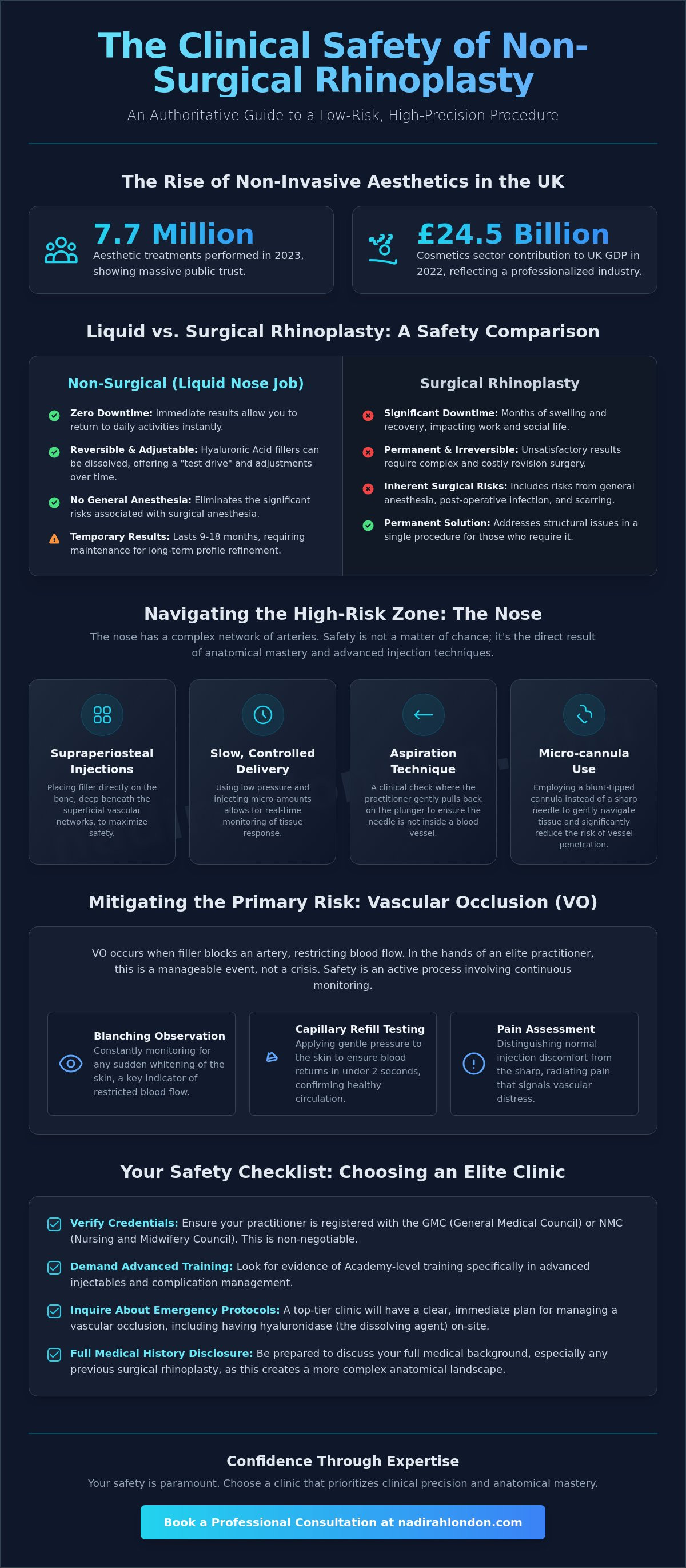
Modern safety profiles are supported by substantial sector growth and increased regulation. The UK cosmetics and personal care sector contributed £24.5 billion to the GDP in 2022, reflecting a highly professionalized industry. In 2023, 7.7 million people in the UK underwent aesthetic treatments, including 900,000 Botox injections. This volume has led to refined safety protocols and a deep clinical understanding of procedural outcomes. Understanding Non-Surgical Rhinoplasty requires recognizing that "safe" is not a static term; it's a result of rigorous training and anatomical knowledge. In 2026, the shift toward national licensing schemes in England ensures that practitioners must demonstrate high-level competency before performing these advanced procedures.
What makes the nose a 'high-risk' zone?
The nose is an anatomical masterpiece with a complex network of terminal arteries. Precision is paramount because the blood supply in this area is intricate. Practitioners must navigate the dorsal nasal and angular arteries with extreme care. While "blindness" is often cited as a primary fear on social media, the actual clinical reality is that such complications are exceptionally rare when advanced techniques are utilized. Safety is achieved through specific injection depths and expert placement:
Supraperiosteal Injections: Placing filler directly on the bone to avoid superficial vascular networks.
Slow Delivery: Controlled, low-pressure injections to monitor tissue response in real-time.
Aspiration: A clinical step to ensure the needle is not within a vessel before product delivery.
Micro-cannula Use: Utilizing blunt-tipped tools to reduce the risk of vessel penetration.
Liquid vs. Surgical: The safety trade-offs
Choosing a liquid nose job eliminates the inherent risks associated with general anaesthesia and invasive surgical trauma. There's no risk of post-operative infection in the way surgery presents. It's an efficient, results-driven approach. The "test drive" benefit allows for aesthetic adjustments as the face ages, which is fundamentally safer for long-term facial harmony. Results typically last between 9 and 18 months, offering a flexible transformation without the months of swelling or permanent commitment required by a surgical rhinoplasty. You get immediate results with zero downtime, making it the preferred choice for the modern, busy professional.
Managing the Risks: Vascular Occlusion and Filler Safety
Clinical precision is the foundation of every successful liquid rhinoplasty. When patients ask, is non-surgical rhinoplasty safe, the answer lies in the practitioner's ability to manage and mitigate vascular risks. Vascular Occlusion (VO) is the primary clinical concern. It occurs when dermal filler is accidentally injected into an artery or compresses a vessel from the outside, obstructing blood flow to the surrounding tissue. In the hands of an elite practitioner, VO is a manageable event rather than a definitive crisis. Mastery of facial anatomy allows for the immediate identification of compromised circulation, ensuring that corrective measures are taken before any permanent tissue damage occurs.
Safety is not a passive state; it is an active clinical process. Advanced injectors utilize specific monitoring techniques during every stage of the procedure. These include:
Capillary Refill Testing: Applying pressure to the skin to ensure blood returns within two seconds, confirming healthy perfusion.
Blanching Observation: Monitoring for any sudden whitening of the skin, which can indicate restricted arterial flow.
Pain Assessment: Distinguishing between expected needle discomfort and the sharp, radiating pain associated with vascular distress.
The 'Slow and Low' Protocol: Delivering micro-amounts of filler under low pressure to prevent bolus-related vessel compression.
The choice of delivery tool also dictates the safety profile. While needles offer pinpoint accuracy for placement directly on the nasal bone, many specialists prefer blunt-tipped micro-cannulas for more superficial layers. Cannulas are designed to slide past blood vessels rather than piercing them, significantly reducing the risk of intra-arterial injection. This sophisticated approach to FDA Dermal Filler Safety Guidelines ensures that every aesthetic enhancement is performed with the highest level of clinical foresight. For those seeking this level of technical mastery, exploring advanced aesthetic training and clinic services provides a clear path to secure, high-impact results.
The Hyaluronidase safety net
Hyaluronidase is a specialized enzyme that acts as a potent dissolving agent for Hyaluronic Acid fillers. Every reputable clinic must maintain an emergency 'crash kit' containing high-concentration Hyaluronidase to instantly reverse injections if a vascular event is suspected. Hyaluronidase is the ultimate 'undo' button for HA fillers, providing a critical layer of security for every patient. A professional response involves immediate infiltration of the enzyme to restore blood flow within minutes.
Common side effects vs. red flags
Understanding the difference between expected recovery and clinical emergencies is vital for post-treatment peace of mind. Most patients experience a predictable healing journey, but awareness of 'red flags' is essential for maintaining safety in the 24 hours following the procedure. Is non-surgical rhinoplasty safe during the recovery phase? Yes, provided the patient follows strict monitoring rules.
Normal Recovery: Mild swelling, localized tenderness, and minor bruising around the injection sites.
Emergency Red Flags: Mottled or 'dusky' skin appearing purple or grey, severe pain that increases over time, or any sudden changes in vision.
The 24-Hour Rule: Avoid strenuous exercise and heat exposure to prevent unnecessary swelling and filler migration.
Candidate Screening: Is it Safe for Your Nose Shape?
Clinical assessment is the first line of defense in aesthetic medicine. Determining whether is non-surgical rhinoplasty safe for your specific profile requires a rigorous anatomical screening. Not every nose is a candidate for liquid refinement. The procedure is highly effective for camouflaging a dorsal hump or correcting minor asymmetries. By placing filler above and below a bridge bump, practitioners create a seamless, straight profile. However, lifting a drooping tip involves navigating a more complex vascular network, requiring extreme precision and a conservative approach to volume.
Medical history and contraindications are non-negotiable safety markers. Practitioners must screen for lidocaine allergies, active autoimmune flares, and local skin infections. According to a Clinical Review of Nonsurgical Rhinoplasty, patient selection is the most significant factor in preventing adverse outcomes. Age requirements are also strictly enforced. In England, it's illegal to administer dermal fillers to anyone under the age of 18 for cosmetic purposes. We prioritize mature, psychologically ready clients who understand that liquid rhinoplasty is a tool for enhancement, not a replacement for major structural reconstruction.
Dorsal Hump Correction: High safety profile; filler is placed on the bone away from major vessels.
Nasal Tip Lifting: Higher complexity; requires advanced knowledge of the columellar artery.
Asymmetry Balancing: Mid-range risk; focuses on lateral volume and facial harmony.
Medical Contraindications: Pregnancy, active infections, or history of anaphylaxis to filler components.
The 'Second-Timer' risk: Post-surgical filler
Surgical history fundamentally alters the safety landscape. Previous rhinoplasty creates scar tissue and fibrosis, which can shift the original positions of blood vessels. This makes the nose a more unpredictable environment for injections. At Nadirah London, we require full disclosure of all previous nasal surgeries. If the internal architecture is compromised, we often pivot to alternative treatments. For instance, PRP/PRF can be used to improve skin quality and texture without the risks associated with adding volume to a post-surgical nose. Safety always supersedes the desire for a quick fix.
Realistic expectations as a safety feature
Precision over volume is our guiding principle. Over-filling the nasal area to achieve a "perfect" Instagram profile can compromise tissue health and lymphatic drainage. A 'less is more' philosophy ensures long-term nasal health and prevents filler migration. If a client requires significant reduction in the size of the nose or major cartilage removal, surgery is the safer and more effective path. Recognizing the limits of Dermal Fillers is a hallmark of a professional clinic. We focus on high-impact, subtle transformations that respect the natural limits of your anatomy.
Your Safety Checklist: Choosing a London Aesthetic Clinic
Selecting an elite destination in London is the ultimate safety measure for any aesthetic procedure. While the procedure itself is highly refined, determining is non-surgical rhinoplasty safe depends entirely on your choice of clinical environment. A premium clinic operates with the transparency of a medical facility and the precision of an architectural firm. In 2026, the London market is more regulated than ever, but consumer due diligence remains the primary safeguard against subpar results.
Your selection process should focus on several non-negotiable clinical markers:
Professional Registration: Verification of your injector's status on the GMC, NMC, or GDC registers.
The Academy Factor: Practitioners who lead Aesthetic Training Courses demonstrate a superior grasp of anatomical complexities. If they teach the technique, they possess the mastery required to mitigate risks.
Emergency Preparedness: Visible protocols for managing complications, including the immediate availability of in-date Hyaluronidase.
Consistency in Results: A comprehensive before-and-after gallery that showcases balanced, natural profiles rather than over-filled trends.
Insurance Coverage: Explicit confirmation of medical malpractice insurance specifically for advanced dermal filler procedures.
The consultation process is a critical safety feature. A professional environment prioritizes clinical screening over immediate sales. Be wary of clinics offering "same-day" treatments without a prior assessment. A mandatory cooling-off period allows for the psychological readiness and medical review necessary for a secure outcome. This measured approach is what separates high-end clinical practice from high-street retail injections.
London-specific safety standards
In 2026, the UK's new national licensing scheme for non-surgical cosmetic procedures, empowered by the Health and Care Act 2022, sets a rigorous benchmark. London clinics leading the sector often voluntarily adhere to JCCP (Joint Council for Cosmetic Practitioners) standards and CQC (Care Quality Commission) guidelines. Always verify that the clinic utilizes genuine, CE-marked Hyaluronic Acid fillers. These products have undergone extensive clinical testing to ensure biocompatibility and predictable degradation within the nasal tissue.
Questions to ask your injector
Direct communication is essential for establishing trust and verifying expertise. Before proceeding, ensure your practitioner can answer these specific queries with clinical confidence:
How many non-surgical rhinoplasty procedures have you performed in the last 12 months?
What is your specific clinical protocol if a vascular occlusion is suspected?
Can you confirm that Hyaluronidase is on-site and ready for immediate use?
Which specific brand of CE-marked filler will be used for my treatment?
A sophisticated, results-driven practitioner will welcome these questions as evidence of an informed client. Transparency is not just a courtesy; it's a clinical requirement. For those seeking the highest standard of precision, explore our professional aesthetic training and clinical services to understand the Nadirah London commitment to safety.
The Nadirah London Standard: Expert Care and Training
Nadirah London operates at the intersection of clinical excellence and academic leadership. When clients ask is non-surgical rhinoplasty safe, our answer is rooted in our status as an elite training center. Our practitioners don't just perform treatments; they define the standards for the industry. This dual identity ensures that every liquid nose job is performed using the most advanced, research-backed safety protocols available in 2026. We utilize the same high-level precision in our clinic that we demand from the professionals we train.
We prioritize anatomical mastery over simple product delivery. Our commitment to education means we maintain an exhaustive understanding of the facial vascular system. We don't just inject; we educate our clients on the clinical logic behind their specific treatment plan. Understanding whether is non-surgical rhinoplasty safe for your profile requires looking at the practitioner's commitment to ongoing clinical education. This level of transparency builds trust and ensures that safety is never compromised for the sake of a temporary trend.
A secure result starts with a personalized treatment plan. At Nadirah London, clinical integrity means we occasionally say 'no'. If a client's anatomy presents an unacceptable risk or if their goals are better suited for surgery, we provide honest, professional guidance. We avoid the risks of over-filling, focusing instead on facial balancing and subtle enhancement. Our standard of care includes:
Detailed Anatomical Mapping: Identifying vessel pathways before any product is delivered.
Advanced Injection Protocols: Utilizing slow-release techniques to maintain tissue health.
Clinical Screening: Rigorous medical history reviews to identify potential contraindications.
24/7 Post-Treatment Support: Dedicated recovery lines for our London aesthetic clients.
Why our Academy-trained injectors are different
Teaching aesthetics requires a higher level of accountability and precision. Our injectors undergo continuous professional development in vascular safety and emergency management. By educating the next generation of practitioners, we stay at the forefront of clinical safety research and product innovation. Explore our Accredited Aesthetic Courses for professionals to see the depth of expertise we bring to every treatment.
Booking your safe consultation in London
Your safety assessment involves a detailed facial analysis and medical review. We design natural, balanced profiles that respect your unique anatomy and long-term health. Expect a professional environment where precision and skill are paramount. High-impact results. Clinical safety. Sophisticated transformation. Book your Non-Surgical Rhinoplasty consultation to begin your profile refinement with the experts who teach the industry.
Securing Your Aesthetic Transformation
Aesthetic refinement in 2026 is defined by a commitment to clinical precision and anatomical depth. The definitive answer to whether is non-surgical rhinoplasty safe depends on the practitioner's mastery of the nasal vascular network and their adherence to rigorous safety protocols. Secure results are a product of advanced candidate screening, the use of premium HA fillers, and the immediate availability of emergency reversal agents. You've seen that safety isn't a passive state; it's an active clinical process.
Nadirah London offers a premium destination for those seeking high-impact results within an authoritative, academy-led environment. As an Accredited Training Academy, we specialize in Dermal Fillers and complex facial anatomy. Our practitioners bring a teacher's precision to every treatment, ensuring your profile refinement follows the highest safety benchmarks in the UK. This is London-based clinical excellence designed for the modern, informed client. Book Your Safety-First Consultation at Nadirah London to begin your journey toward a more balanced, sophisticated profile. Your transformation is within reach.
Frequently Asked Questions
Can non-surgical rhinoplasty cause blindness?
Clinical blindness is an exceptionally rare complication associated with intra-arterial injection and vascular occlusion. Advanced practitioners mitigate this risk through a deep understanding of nasal anatomy and the use of specific injection depths. Utilizing micro-cannulas and supraperiosteal placement ensures the product remains far from the ocular blood supply. This high level of technical precision is essential for maintaining ocular safety during profile refinement.
What is the most dangerous part of a liquid nose job?
The nasal tip and the area around the columella are considered the highest-risk zones due to their complex terminal arteries. Accidental injection into these vessels can lead to vascular occlusion, which obstructs blood flow to the skin. Mastery of these specific anatomical landmarks is paramount. Elite injectors use slow-delivery techniques and low-pressure injections to monitor tissue health in real time, preventing compression or arterial blockage.
Is the filler used in the nose permanent or temporary?
Modern clinics exclusively utilize temporary Hyaluronic Acid (HA) fillers for nasal procedures. These specialized products typically last between 9 and 18 months before being naturally metabolized by the body. Temporary fillers are the clinical preference because they are biocompatible and immediately reversible. This reversibility is a fundamental safety feature, allowing for adjustments or total removal using a dissolving enzyme if required by the patient.
How do I know if my injector is qualified for nose fillers?
Qualified injectors must hold active registration with professional medical bodies such as the GMC, NMC, or GDC. Determining if is non-surgical rhinoplasty safe at a particular destination requires verifying the practitioner's training credentials and Academy status. Look for specialists who lead aesthetic training courses for other medical professionals. This teaching status indicates a superior grasp of the latest safety protocols and anatomical mastery.
What happens if I don't like the results of my non-surgical nose job?
If the aesthetic outcome does not meet your expectations, the filler can be instantly dissolved using Hyaluronidase. This enzyme breaks down the Hyaluronic Acid, returning the nose to its original shape within 24 to 48 hours. This flexibility provides peace of mind for those concerned about permanent changes. It allows for a "test drive" of a new profile with the security of a clinical undo button.
Can I have a liquid nose job if I've already had surgery?
Previous surgical rhinoplasty significantly increases the complexity and risk profile of liquid injections. Scar tissue and altered blood vessel positions make the nose more unpredictable, requiring extreme caution. Full disclosure of surgical history is mandatory during your clinical screening. While some post-surgical cases are suitable for filler, others may be better candidates for PRP/PRF or skin specialist treatments to improve skin quality without adding volume.
How long does it take for nose filler to settle safely?
Nasal filler typically settles and integrates with the surrounding tissue within 14 days. While the initial transformation is visible immediately, minor swelling may persist for the first 48 hours. Patients should avoid wearing heavy glasses or applying pressure to the bridge during this two-week window. Following these post-treatment instructions ensures the product remains in its intended position for a stable and secure long-term result.
Is there any downtime or recovery period required?
Minimal downtime is required, making this an efficient choice for busy professionals. Most patients return to their daily activities immediately after leaving the clinic. Clinical precautions include avoiding strenuous exercise, saunas, and alcohol for 24 hours to prevent unnecessary swelling or bruising. This rapid recovery profile is a significant advantage over surgical alternatives, which often require weeks of downtime and involve significant post-operative trauma.


Comments