

Avoiding Botched Lip Fillers: The Expert Guide to Safe Aesthetics in 2026
- The Pond Parlor

- 5 days ago
- 11 min read
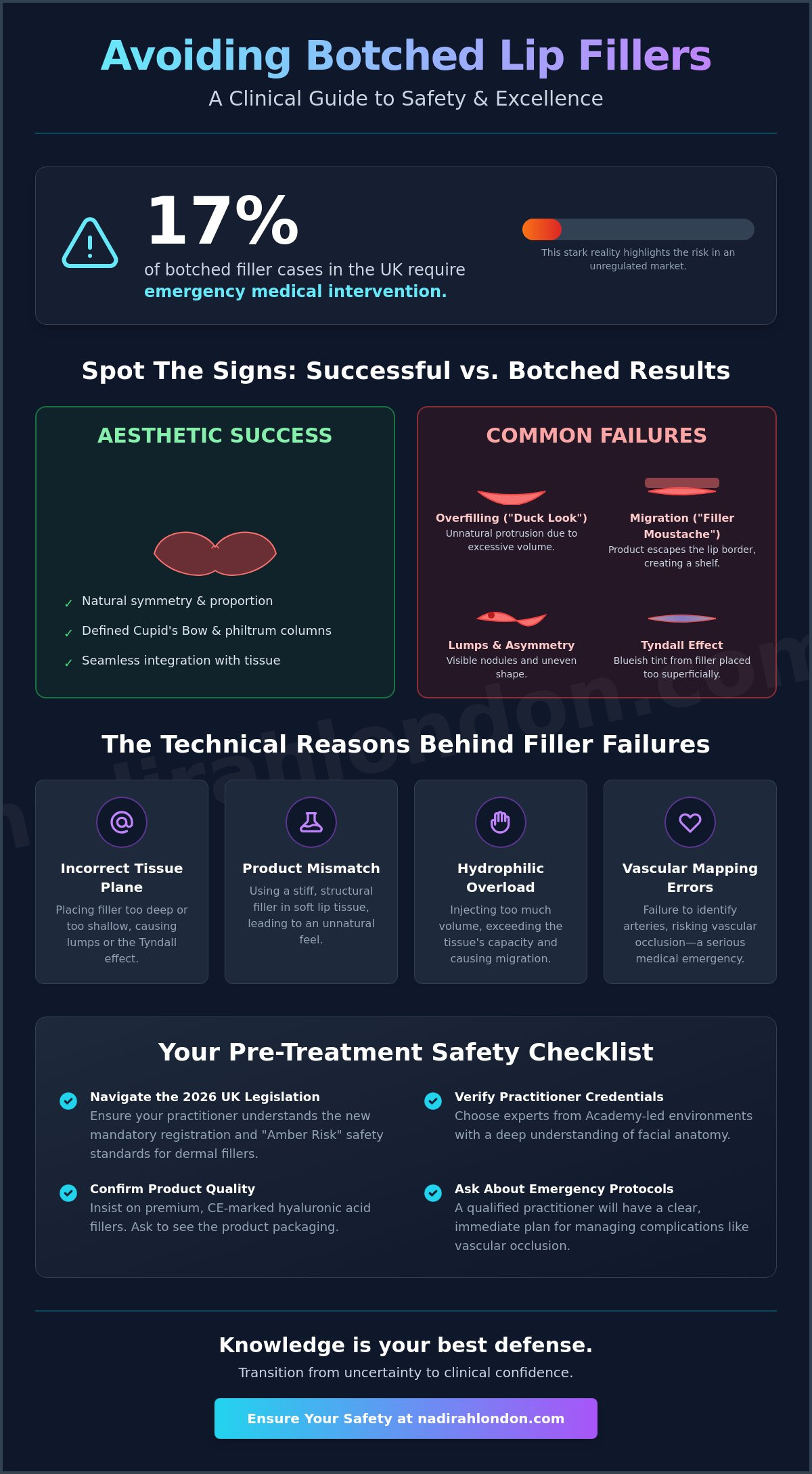
Did you know that 17% of botched filler cases in the UK require emergency medical intervention? It is a stark reality in an industry where precision is often sacrificed for profit. You likely feel the weight of this risk, coupled with confusion over London's erratic pricing and the anxiety of the procedure itself. Avoiding botched lip fillers requires more than luck. It demands a clinical understanding of facial anatomy and a commitment to high-end safety standards.
We agree that your safety and aesthetic results are non-negotiable. This guide provides the technical blueprint for a successful, high-impact transformation. You will learn to navigate the new July 2026 mandatory registration laws, identify practitioner red flags, and understand the "Amber Risk" classification of dermal injections. We cover the essentials: natural symmetry, micro-dosing for undetectable volume, and emergency protocols. Knowledge is your best defense. Prepare to transition from uncertainty to clinical confidence.
Key Takeaways
Identify visual indicators of compromised results, including overfilling, migration, and the Tyndall effect.
Master the technical criteria for avoiding botched lip fillers by recognizing the dangers of incorrect injection depth and product mismatch.
Navigate the 2026 UK aesthetics legislation to ensure your practitioner meets mandatory accreditation and "Amber Risk" safety standards.
Utilize a professional pre-treatment checklist to verify the use of premium, CE-marked hyaluronic acid fillers.
Discover the clinical advantages of Academy-led environments for achieving high-end, symmetrical, and natural-looking transformations.
Table of Contents
What Does a Botched Lip Filler Actually Look Like?
A "botched" result is defined by a failure in clinical integrity or aesthetic harmony. In the context of injectable fillers, these failures range from minor asymmetry to life-altering vascular complications. For anyone focused on avoiding botched lip fillers, recognizing these early warning signs is the first step toward securing a high-end transformation.
To better understand the visual markers of poorly placed product, watch this expert breakdown of migration and prevention:
Visual indicators of a botch often begin with overfilling, commonly referred to as the "duck look." This occurs when excessive volume is placed without regard for the natural lip anatomy, causing the tissue to protrude unnaturally. Other signs include palpable lumps, visible nodules, and severe asymmetry that persists well beyond the initial healing phase. Clinical emergencies are more severe and require immediate intervention. Watch for blanching (white spots), extreme pain that feels disproportionate to the procedure, or skin mottling, which can indicate a vascular occlusion.
Aesthetic Failures vs. Clinical Complications
Aesthetic failures involve a loss of facial definition. You might see "sausage lips" where the philtrum columns and Cupid's bow are completely flattened. These are usually the result of poor mapping or outdated injection techniques. Clinical complications are deeper issues such as bacterial infections, allergic reactions, or tissue necrosis. It's vital to distinguish these from normal healing. Significant swelling and minor bruising are expected within the first 48 hours; however, if distortion or extreme pain remains after the first week, it's a sign that the clinical integrity has been compromised.
The Tell-Tale Signs of Filler Migration
Migration occurs when the hyaluronic acid escapes the lip tissue and moves into the skin above the vermilion border. This creates a "filler mustache" or a shelf-like projection that is particularly visible when viewed in profile. For those prioritizing avoiding botched lip fillers, understanding the cause is essential. Migration is often triggered by poor injection depth, over-treatment of the area, or using high-pressure techniques that force product along tissue planes. A "shelf" above the lip isn't a sign of luxury volume; it's a clear indicator of lost structural precision.
The Technical Reasons Behind Lip Filler Failures
A successful aesthetic outcome is an exercise in clinical physics. While the previous section detailed the visual markers of failure, the root causes are purely technical. Avoiding botched lip fillers requires a practitioner who masters the specific rheology of hyaluronic acid. Technical failures typically result from four specific clinical oversights:
Incorrect Tissue Plane: Placing product too superficially or too deep within the labial layers.
Rheology Mismatch: Using high-G-prime (stiffer) fillers intended for structural contouring in soft mucosal tissue.
Hydrophilic Overload: Injecting volumes that exceed the interstitial space, leading to inevitable product migration.
Vascular Mapping Errors: Failing to identify the specific depth and variation of the superior labial artery.
Technical precision is the primary safeguard against long-term dissatisfaction. Adhering to established safety protocols, such as the FDA Dermal Filler Do's and Don'ts, is non-negotiable for clinical integrity. Excellence in this field is built on anatomical knowledge rather than aesthetic guesswork. Sophisticated results are a direct byproduct of this technical discipline.
The Danger of Incorrect Injection Depth
The lip anatomy comprises the mucosa, the orbicularis oris muscle, and the subcutaneous fat. If a practitioner places filler too superficially, the product creates visible nodules or a blueish tint known as the Tyndall effect. At Nadirah London Beauty Clinic & Academy, we teach practitioners to utilize haptic feedback to identify the precise mucosal layer. This level of technical training is essential for avoiding botched lip fillers and ensuring the product remains structurally sound. Proper placement ensures the filler integrates seamlessly with natural tissue movement.
Russian Lips: High Reward, High Risk
The Russian Lip technique utilizes vertical injection channels to create height without unnatural projection. However, this method increases the risk of product tracking back through the needle entry points if the tissue is over-pressurized. A "tented" border is the goal; a blurred, migrated shelf is the technical failure. Mastery of this vertical approach is a core component of our aesthetic training courses. It requires a sophisticated understanding of tissue tension and volume to achieve the flat, high-impact profile without compromising the vermilion border's sharp definition.
Navigating the London Aesthetics Market Safely
London is a global hub for aesthetic innovation, yet its density creates a landscape where clinical excellence often competes with high-risk shortcuts. Avoiding botched lip fillers in a market this saturated requires a commitment to vetting practitioners beyond their social media presence. The "London Discount" is a primary red flag for safety. Offers for £99 fillers are not a bargain; they are a sign of compromise. High-quality hyaluronic acid (HA) products, clinical insurance, and sterile overheads cannot be sustained at these rates without sacrificing patient safety.
The regulatory environment in the UK has shifted significantly. As of July 2026, new legislation mandates that all practitioners performing cosmetic injectables must be registered and accredited. Under this scheme, dermal fillers are classified as "Amber Risk" procedures. This means any non-healthcare professional must be licensed and supervised by a named, regulated healthcare professional. Professional accountability is non-negotiable. A reputable clinic must hold medical malpractice cover and operate from a fixed clinical location. Mobile injectors or "home-visit" services lack the sterile environment and immediate access to emergency reversal agents required for medical procedures.
London Clinic Red Flags to Watch For
Vigilance during the initial contact phase is essential. Watch for these indicators of a low-standard environment:
Skipped Consultations: Any practitioner who bypasses a medical history review or a "cooling off" period.
Product Anonymity: Clinics that refuse to show the box, batch number, or brand of the filler. Consult the FDA guidelines on dermal fillers to understand why using approved, traceable products is vital for your health.
Inconsistent Portfolios: A lack of clear, high-resolution before-and-after imagery that shows consistent anatomical precision.
High-Pressure Sales: Tactics that encourage immediate, high-volume injections without a staged treatment plan.
Why Premium Pricing Reflects Safety
Premium pricing is a direct reflection of clinical security and product integrity. High-grade HA fillers, such as Juvéderm or Restylane, are engineered for bio-compatibility and predictable dissolution. These products carry higher procurement costs than unregulated alternatives. Furthermore, you're investing in a practitioner's continuous professional development (CPD) and their mastery of advanced complications management. The "Botch Tax" is a significant financial and emotional burden. Dissolving poorly placed filler and correcting the underlying tissue damage often costs significantly more than the initial premium treatment. Efficiency in aesthetics means getting it right the first time.
Your Pre-Treatment Consultation Checklist
A professional consultation is a diagnostic session, not a sales pitch. It is the most critical phase for avoiding botched lip fillers. You are commissioning a medical-grade aesthetic procedure, which requires a rigorous vetting process. Start by auditing the practitioner's training pedigree. An injector trained at a high-end institution, such as those attending our aesthetic training courses, understands the complex interplay of vascular mapping and product rheology. Clinical precision is a product of elite education.
Verify the specific product. Insist on seeing the packaging to ensure the filler is an FDA-approved or CE-marked Hyaluronic Acid (HA) gel. Unlabeled or generic "house" fillers lack the clinical testing required to guarantee predictable degradation. Ask specifically about "The Dissolver", known clinically as Hyaluronidase. A reputable clinic must have this enzyme on-site to resolve vascular occlusions or aesthetic dissatisfaction immediately. Finally, assess the environment. A high-end transformation requires a sterile, clinical setting with hospital-grade sanitation. Avoid any practitioner operating out of residential spaces or "pop-up" salons where infection control is compromised. Your "exit strategy" should be discussed before the first needle entry. This includes a clear protocol for adjustments or dissolving if the initial result does not meet the agreed aesthetic goals.
5 Questions to Ask Your Injector
1. What is your medical or aesthetic training background? Verify their registration under the mandatory July 2026 legislation.
2. Which specific filler brand are you using for my lips and why? They should explain the choice based on your specific tissue density.
3. How do you manage a vascular occlusion if it happens? They must have a written emergency protocol and dissolving agents ready.
4. Can I see your portfolio of healed results? Freshly injected lips hide flaws, like migration, that only appear after 4 weeks.
5. Do you have an emergency contact number for aftercare? Safety requires 24/7 accountability during the initial healing phase.
Understanding Aftercare Compliance
A "botched" look isn't always the result of poor injection technique. Patient compliance is the final pillar of avoiding botched lip fillers. Touching the treated area, applying intense heat, or engaging in vigorous exercise within the first 48 hours can displace the product. Hydration is equally vital. HA fillers are hydrophilic; they attract water to create volume. Without proper hydration, the filler may appear uneven or settle poorly. Patience is a clinical necessity. You must wait 14 days for the initial inflammatory response to subside before judging the final symmetry and volume.
The Nadirah London Standard: Clinical Excellence & Academy Expertise
Nadirah London represents the intersection of luxury aesthetics and academic rigor. Choosing an Academy-led clinic is the ultimate strategy for avoiding botched lip fillers. We don't just perform these procedures; we define the technical standards for the next generation of injectors. Our clinical environment is designed for those who prioritize safety, precision, and sophisticated results over high-street convenience. We're committed to the technical craft of physical enhancement, ensuring every injection is a calculated step toward facial harmony.
Academy-Led Safety: Clinical protocols derived from our own intensive training curriculum.
Anatomical Precision: Rigorous mapping of the superior labial artery and mucosal planes to prevent vascular compromise.
Facial Harmony: Bespoke volume calibrated to your unique philtrum height, lip-to-chin ratio, and bone structure.
Emergency Readiness: Immediate on-site access to Hyaluronidase and advanced medical complications management.
The Nadirah London consultation is a high-level diagnostic event. We analyze the dynamic movement of your lips, the structural support of the perioral area, and your personal aesthetic goals. This comprehensive approach is the only way to ensure long-term satisfaction and avoid the common pitfalls of over-treatment. By focusing on the technical "what" and the anatomical "where," we deliver results that are both safe and aspirational.
For patients seeking this level of anatomical mastery in other regions, Best Filler Clinic offers a similar commitment to precision and facial harmony.
Corrective Aesthetics: Fixing a Botch
A significant portion of our clinical work involves resolving the errors of less experienced practitioners. We specialize in the "clean slate" approach. This involves using Hyaluronidase to safely dissolve migrated, lumpy, or asymmetrical filler that has compromised the natural lip border. We don't just fix the aesthetic; we restore the health of the tissue. Our case studies demonstrate a consistent ability to transform distorted results back into a state of sophisticated beauty. Re-injection is only considered after a minimum of 14 days, ensuring a perfectly stable base for new, precise volume.
Book Your Safe Consultation at Nadirah London
Experience luxury aesthetics in a professional London clinical setting. Consult with practitioners who also teach the next generation of injectors at our academy. We provide a premium destination for those seeking serious aesthetic interventions without the risks associated with unregulated clinics. Your transformation deserves the highest level of clinical skill and anatomical precision. Secure your safe lip transformation at Nadirah London Beauty Clinic.
Secure Your High-End Transformation
Clinical precision is the only defense against compromised aesthetics. Navigating the 2026 landscape requires a technical eye for detail and an uncompromising stance on practitioner accreditation. Avoiding botched lip fillers is a matter of choosing elite expertise over high-street convenience. Your safety is a byproduct of our rigorous training standards and anatomical mastery. Our clinical environment offers:
Accredited Aesthetic Training Academy: Setting the technical benchmarks for the industry.
Specialists in Russian Lip & Natural Fillers: Focused on vertical injection precision and anatomical symmetry.
Comprehensive Complication Management Protocols: Expert-led dissolution and corrective aesthetic pathways.
Your journey to refined volume should be defined by safety, sophistication, and predictable results. We invite you to experience the difference that academy-level expertise and clinical precision make in your aesthetic results. Book a Consultation with our London Aesthetic Experts and secure the high-impact transformation you deserve. Confidence begins with clinical excellence.
Frequently Asked Questions
Can botched lip fillers be fixed?
Yes, most hyaluronic acid-based failures are reversible through the administration of Hyaluronidase. This specialized enzyme effectively breaks down the filler particles, allowing for a "clean slate" approach to your aesthetic journey. It's a foundational step in avoiding botched lip fillers by removing migrated or lumpy product before starting a new, precise treatment plan that respects your natural anatomy and facial harmony.
How can I tell if my lip filler is migrated or just swollen?
Swelling is an internal inflammatory response that typically peaks within 48 hours of treatment and remains symmetrical. Migration, however, is the physical movement of the product outside the vermilion border, creating a visible "mustache" or shelf-like projection. If the distortion persists beyond the initial 14-day healing window, it's likely a technical failure rather than normal post-procedure inflammation. Professional assessment is required for a definitive diagnosis.
Is it normal to have lumps in my lips after filler?
Minor, soft lumps are a common part of the integration process during the first two weeks of healing. These usually resolve as the hyaluronic acid settles into the lip tissue and attracts natural hydration. However, persistent, hard, or visible nodules that remain after 14 days are not normal. They often indicate poor injection depth or a product mismatch that requires clinical intervention or professional massage to resolve.
What are the early signs of vascular occlusion?
Early indicators of vascular occlusion include immediate blanching of the skin, intense pain, and a lace-like mottling pattern. These symptoms signal that blood flow to the tissue is obstructed, which is a clinical emergency. It requires immediate intervention with high-dose Hyaluronidase to prevent tissue necrosis. Professional injectors must always have these reversal agents on-site and ready for immediate use during any dermal filler procedure.
How much does it cost to dissolve botched lip filler in London?
Corrective dissolution costs in London reflect the practitioner's expertise and the clinical resources required for safe enzyme administration. While prices vary across Harley Street and luxury clinics, the investment covers the medical-grade Hyaluronidase, the required patch testing, and the follow-up assessment. Prioritizing clinical skill and safety over the lowest price is essential for a successful and safe resolution to any filler complication you may be experiencing.
How long should I wait to fix a bad lip filler result?
You must wait at least 14 days for the initial inflammatory response to fully resolve before attempting a correction. Dissolving product while the tissue is still swollen can lead to imprecise results and unnecessary tissue trauma. Once the "clean slate" dissolution is complete, we recommend waiting another 14 days before re-injecting to ensure the lip tissue has fully stabilized and is ready for new, precisely placed volume.
Are cheap lip fillers always a bad idea?
Cheap lip fillers are a significant risk factor because they often indicate a compromise in clinical standards. Professional-grade hyaluronic acid products and medical insurance overheads cannot be sustained at discount rates. Avoiding botched lip fillers requires an investment in a practitioner who prioritizes anatomical precision and high-end safety protocols over low-cost marketing. Quality results are always a product of elite training and premium, regulated materials.
What should I do if I suspect my injector is unqualified?
Verify their credentials against the July 2026 UK aesthetics legislation immediately. This new law requires all practitioners to be registered and accredited to perform "Amber Risk" procedures like dermal injections. If they can't provide proof of their license or the name of their supervising medical professional, you should seek a different clinic. Precision and accountability are the hallmarks of a qualified, high-end aesthetic injector in today's market.


Comments